
Anderson County Criminal History Checks
The official starting point for most local searches is Anderson County Courts Records Inquiry, the county's Odyssey Public Access portal. It separates criminal cases, calendars, jail records, and jail bonds. The site posts a prior-business-day warning, so a new arrest may not be visible at once. Search with a full name and date of birth when known, and compare the court, case number, booking date, and charge before treating a result as a match.
A complete Anderson County criminal record check may need more than one custodian. The clerk holds the filed case. The sheriff holds booking and custody data. Texas DPS receives reported arrest cycles and dispositions. Use this order:
- Choose the criminal, jail, or jail-bond category that fits the question.
- Enter a name, birth date, case number, or booking date.
- Compare identifiers and avoid relying on a name alone.
- Open the case or booking detail and note its source date.
- Ask the proper clerk for a certified copy or use fingerprints for a personal DPS review.
The official county portal shows how the search categories are split.
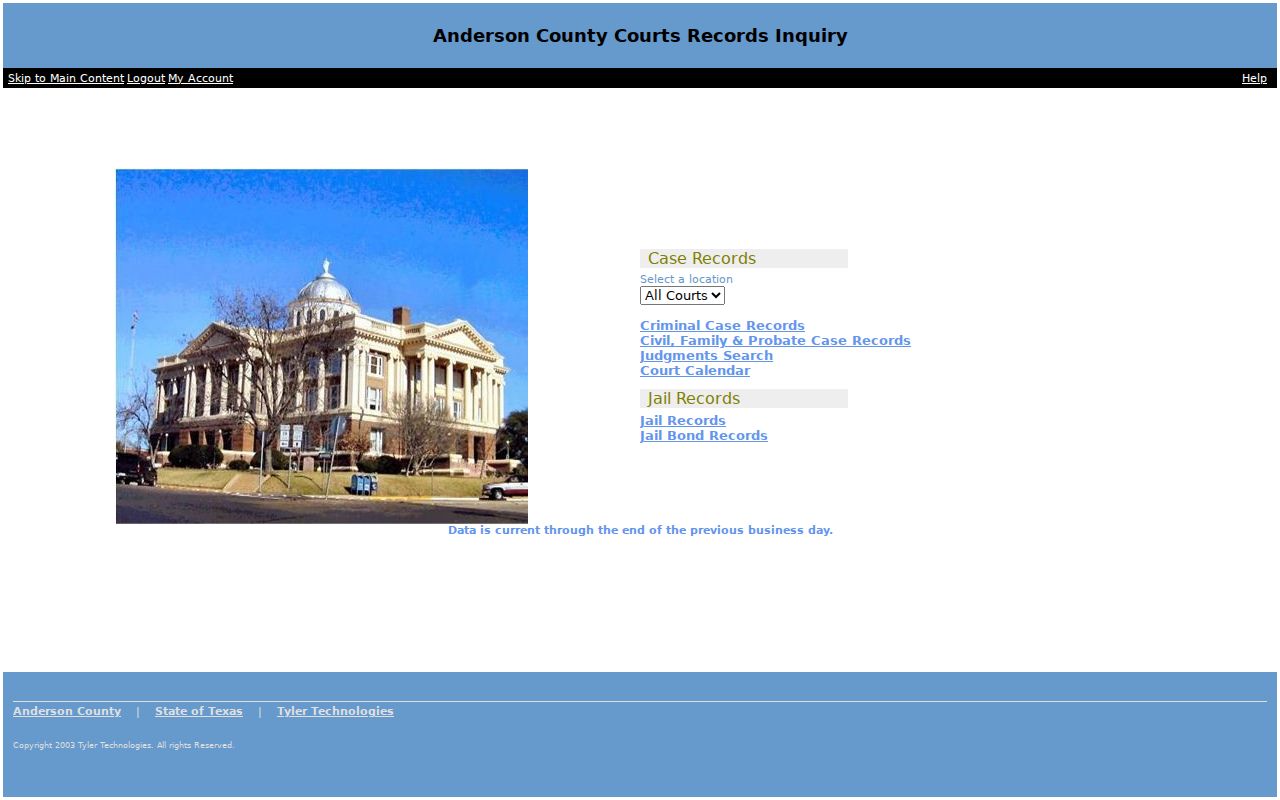
That division matters because a jail entry and a court judgment are not interchangeable.
Search Anderson Odyssey Fields
Odyssey supports several routes into Anderson County criminal case records. A case-number search accepts the full number or its component parts. Party searches allow business or personal names, and the personal-name form includes last, first, middle, birth date, and a sound-alike option. Cross-reference and citation searches help when a number came from another agency. Narrow fields are useful, but too many filters can hide a record with an incomplete field.
| Search route | Useful fields | Best use |
|---|---|---|
| Case | Case number or component parts | Known court file |
| Party | Name, birth date, sound-alike | Unknown case number |
| Cross-reference | Number and type | Agency reference |
| Citation | Citation number | Ticket-linked matter |
| Jail | Name, booking/release date, booking number | Custody record |
The official Anderson County home page links readers to Odyssey and statewide court resources.

Using the county's own link helps distinguish the official index from third-party name sites.
Official Background Checks in Texas
The Texas DPS Criminal History Conviction Name Search is the statewide public product. It discloses convictions and deferred adjudications that Texas law permits DPS to release. Each search credit costs $1. A no-match result still uses a credit, and opening another possible match uses another. Credit-card purchases add 2.25 percent per credit plus 25 cents per transaction. Mail form CR-42 costs $10 per search.
DPS warns that a name search can miss the intended person or return a similar name. It is not a complete fingerprint history. The portal's own instructions show that distinction.
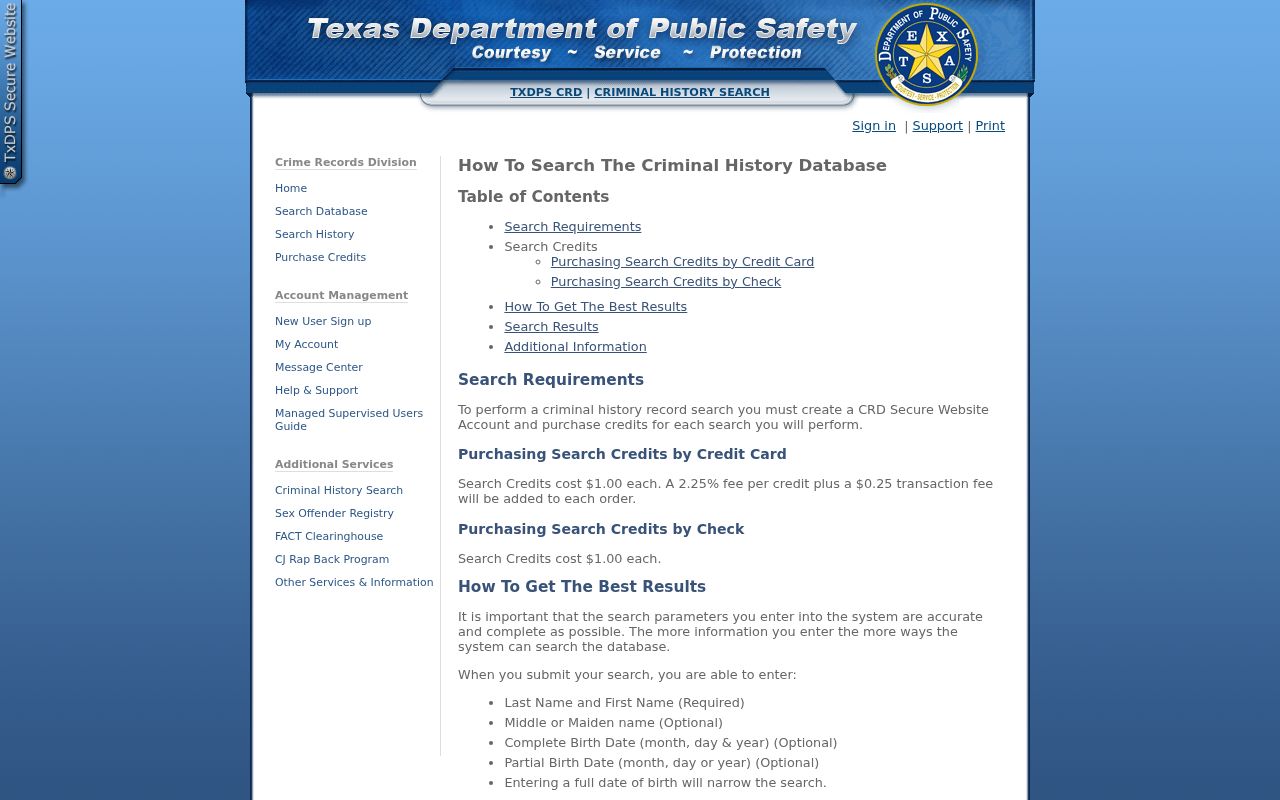
Use the public name product for disclosed statewide outcomes, not as proof that no other record exists.
| Service | Posted amount | Scope |
|---|---|---|
| Online DPS search credit | $1 | Public conviction and deferred data |
| Mail CR-42 search | $10 | Public-history request |
| FAST capture | $10 component | Personal fingerprint review |
| DPS fingerprint review | $15 component | Personal Texas record |
FAST Fingerprint Record Review
A person reviewing their own Texas record can use Fingerprint Applicant Services of Texas, operated for DPS by IDEMIA through IdentoGO. The posted components are $10 for FAST capture and $15 for DPS, normally $25 with the correct service code. Appointments are made through IdentoGO enrollment or by phone at 1-888-467-2080 from 8 a.m. to 9 p.m. Central.
The fingerprint route is stronger than a name match because the prints tie the request to one person. It is also the right route for spotting a Texas repository entry that may need correction. The appointment interface is shown by the official provider.
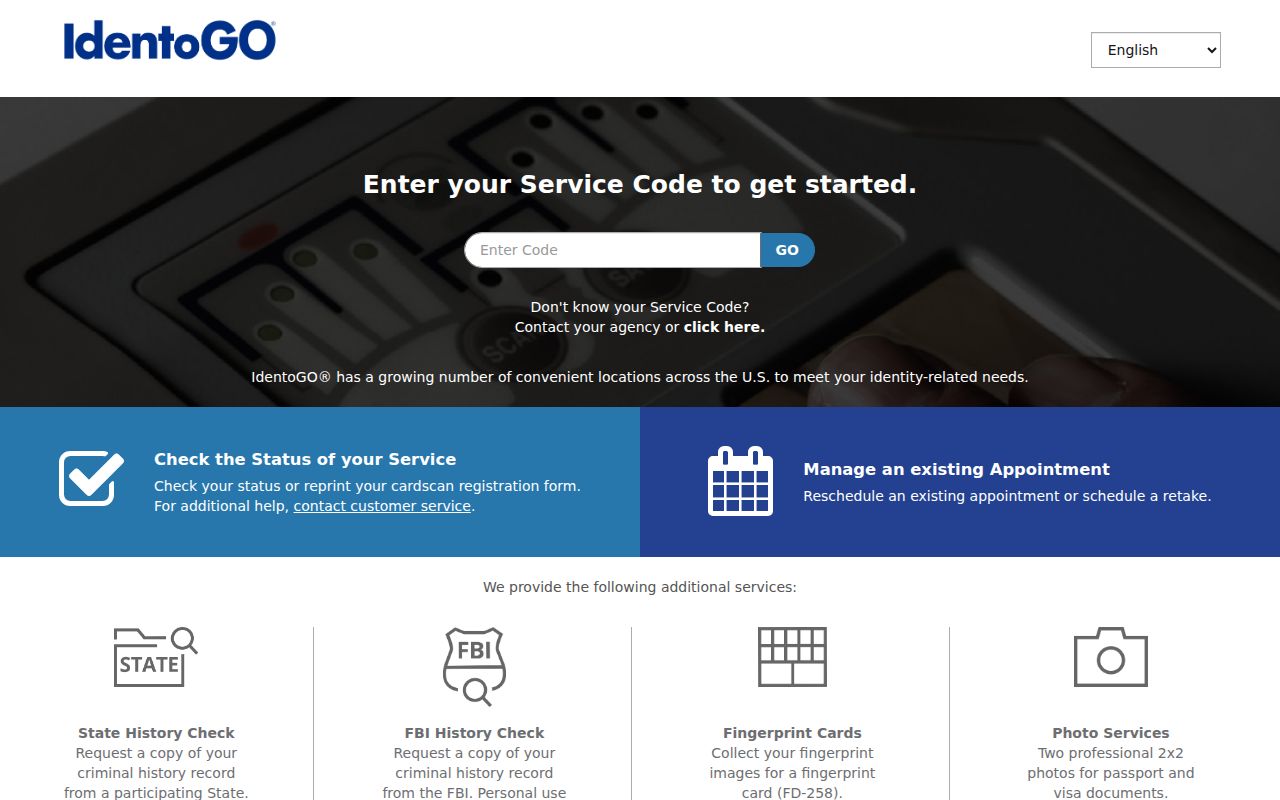
Bring the required identity documents and use the DPS service code that fits a personal record review.
Kinds of Criminal Records
Anderson County criminal history is assembled from records created at different stages. Police incident reports describe an event and response. Sheriff booking files document intake, charges, bond, and release activity. Clerks preserve filed allegations, docket events, orders, and outcomes. DPS maintains reported computerized criminal history. The registry and corrections systems serve still different purposes.
- Arrest and booking records: custody data from the sheriff and arresting agency.
- Court case files: charges, hearings, orders, judgment, and sentence.
- DPS history: reportable arrest cycles and outcomes received from agencies.
- Warrants: court-issued process that may require a clerk or sheriff check.
- Custody and registry records: TDCJ, federal, and Texas registry data.
The Anderson County District Clerk explains the felony-record office and its forms.

The clerk is the custodian for district criminal case files, not the jail custodian.
Two Clerks Split Case Files
Felony cases in the 3rd, 87th, 349th, and 369th District Courts are kept by the District Clerk at 500 North Church Street in Palestine. Criminal deputy lines are 903-723-7463 for the 3rd and 369th courts and 903-723-7417 for the 87th and 349th courts. The District Clerk counter is in Room 18 and generally operates weekdays from 8 a.m. to 5 p.m., with a noon-to-1 p.m. closure and a 4:30 p.m. new-filing cutoff.
Class A and B misdemeanors generally go through county-level courts. The County Court at Law has that misdemeanor role, plus concurrent felony and appellate jurisdiction described on its official page.

Municipal and justice courts keep fine-only Class C matters, so an Odyssey search should not replace a call to the court that issued a local case.
Anderson County Criminal Records: What They Contain
A useful record shows both identity clues and procedural status. Read the source label first. An arrest charge may later be changed, rejected, dismissed, deferred, or resolved by conviction or acquittal. A docket is the running event list. A disposition is the result of a charge. A judgment is the signed court decision. Those terms prevent an arrest entry from being mistaken for a final outcome.
| Name & identifiers | Names, aliases, birth date, and other source-specific matching fields. |
|---|---|
| Arrest / booking | Booking number, agency, intake and release dates, charge, bond, and facility. |
| Case filing | Case number, court, filed charge, attorneys, hearings, and docket events. |
| Disposition | Dismissal, acquittal, plea, conviction, deferred adjudication, or other result. |
| Sentence | Confinement, fine, community supervision, and court conditions when public. |
| Custody status | County jail, TDCJ, federal custody, release, or supervision data by system. |
- Arraignment
- The hearing where the accused is told the charge and enters a plea.
- Deferred adjudication
- Community supervision without a final conviction at that point, subject to later court action.
- Capias
- A court order directing that a person be taken into custody.
Copies From Anderson Clerks
The District Clerk copy form asks for the case number, party name, requester contact details, an older-case year or range, and whether the document should be certified. If the case number is unknown, the posted lookup charge is $5. Printed pages cost $1 each, emailed documents cost $1 per document, and certification costs $5 per document. Unscanned or offsite material may take up to 72 hours.
The official District Clerk copy-request form displays the required fields and fee examples.

Two emailed certified documents total $12 under the form's example, while a certified nine-page printout totals $14.
Checks have not been accepted since 2020. The office lists cash, money order, debit, and credit as payment methods. A certified copy comes from the clerk and carries formal authentication; a portal printout does not become certified merely because it displays the same case.
Texas Public Access Laws
The Texas Public Information Act governs requests to agencies, but court records also operate under judicial access rules. Government Code Chapter 411 controls criminal-history dissemination and limits the DPS public product. Some data stays closed or redacted, including juvenile records, victim identifiers, active-investigation details, private identifiers, and records covered by an expunction or nondisclosure order.
Key Texas laws:
Government Code Chapter 552 gives the public a request process and permits specific exceptions.
Government Code Chapter 411 governs criminal-history release and nondisclosure.
Code of Criminal Procedure Chapter 55A sets current expunction rules.
Penal Code Chapter 12 defines felony and misdemeanor punishment classes.
Ask the office that created the record for agency reports. Ask the clerk for a court file. A request sent to the wrong custodian may be delayed or redirected.
Jail, Court, and DPS Differ
One event can create four tracks: a police report, a sheriff booking, a prosecutor's filing and clerk case, and a DPS arrest cycle with a later reported disposition. Anderson County Odyssey can show the case and booking branches, but neither branch is the full statewide fingerprint record. The DPS name product shows only releasable Texas convictions and deferred adjudications.
Record flow: Arresting agency › Anderson County Jail › prosecutor and court clerk › Texas DPS repository.
Check timestamps. The county portal warns that its data is current through the prior business day. For immediate custody, call the Anderson County Sheriff/Jail at 903-729-6068. For a filed court outcome, follow the correct clerk. For a personal identity-confirmed state review, use FAST fingerprints.
Anderson County Sheriff/Jail
1200 E. Lacy St., Palestine, TX 75801
903-729-6068
Anderson District Clerk
500 N. Church St., Room 18, Palestine, TX 75801
903-723-7463
County Court at Law
500 N. Church St., third floor, Palestine, TX 75801
903-723-7469
The physical offices also mark the boundary between records. A sheriff employee can confirm custody or route a request for an agency record, but the sheriff cannot certify a district-court judgment. The District Clerk can authenticate its felony files, but it does not replace DPS for a fingerprint-confirmed statewide review. County Court at Law handles its own misdemeanor and concurrent matters. State the kind of record and the likely court when calling, and keep the case or booking number at hand. That short description helps the office send the request to the right custodian without treating every criminal-history question as one database search.
Restricted, Sealed & Expunged Records
Texas now places its main expunction provisions in Code of Criminal Procedure Chapter 55A. Expunction can require agencies to remove or destroy eligible records as the statute and order direct. An order of nondisclosure under Government Code Chapter 411 is different: it limits public disclosure of qualifying history but does not erase every government-held record.
Eligibility turns on the charge, result, waiting period, later conduct, and other facts. A dismissed case is not automatically expunged, and a missing online result does not prove an order exists. Juvenile cases, victim data, sealed warrants, and confidential supervision or registry fields may also be unavailable for reasons unrelated to expunction. Obtain the signed order or ask the clerk when confirming restricted status.
Errors follow another path. DPS allows a subject to review and challenge their own record. Court docket errors should be raised with the clerk that keeps the original case. The source agency must usually correct its own contribution before linked systems can reflect the change.
Choose the Right Inmate Locator
Odyssey Jail Records is for Anderson County custody. A person sentenced into state prison appears through the TDCJ Online Inmate Search, which accepts a TDCJ or state identification number or name. Telephone status is available at 936-295-6371 or 800-535-0283 on weekdays from 8 a.m. to 5 p.m.; an exact birth date is needed when the identification number is unknown.
The official TDCJ interface shows why county and state searches must remain separate.
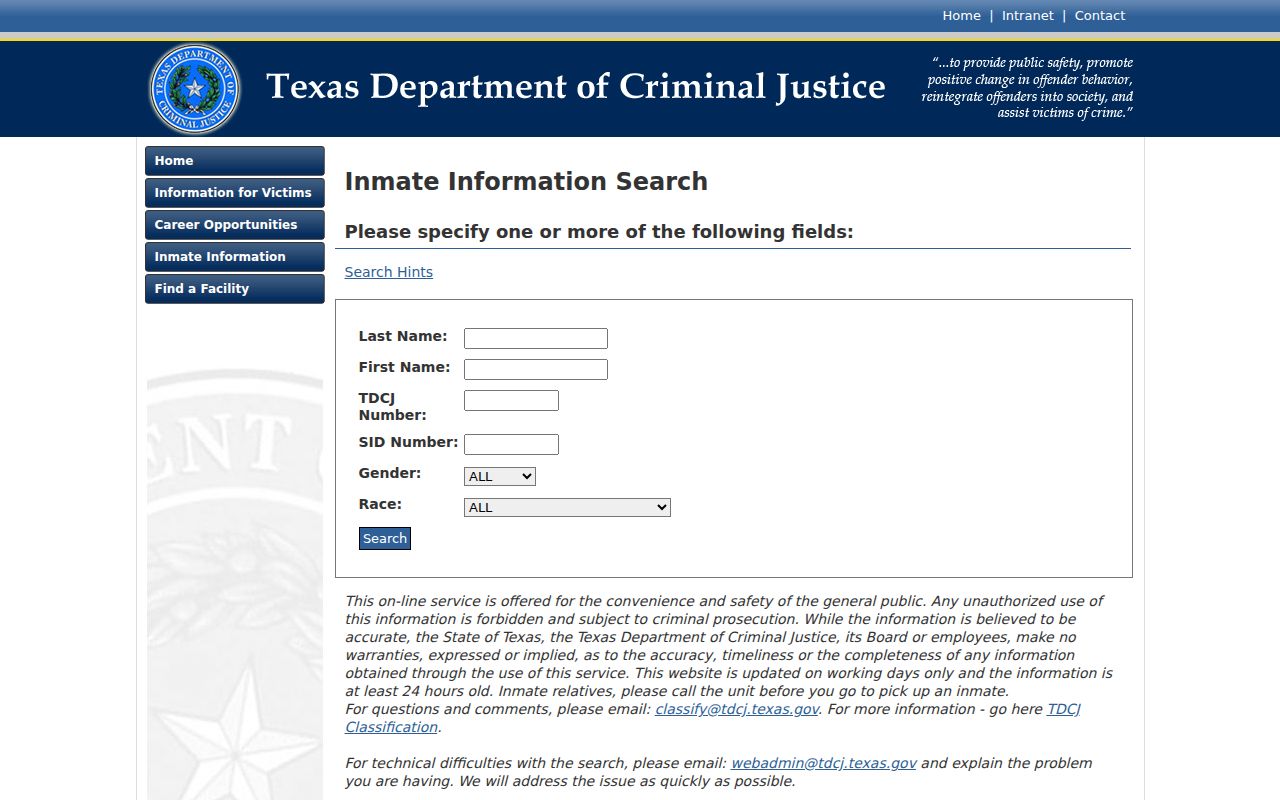
Federal custody uses the Bureau of Prisons locator. A result marked released or not in BOP custody does not rule out custody in Anderson County or TDCJ.
Anderson County Registry Searches
The Texas Public Sex Offender Registry supports name, address, county, map, and SID searches. Anderson County can be selected in the county filter. Profiles may show a photograph, aliases, physical descriptors, registry status, verification details, offense and adjudication data, residence information, and risk level. Texas registration length is driven by the reportable offense and disposition, not merely by a simple federal tier label.
The official DPS registry screen is the source for current public fields.
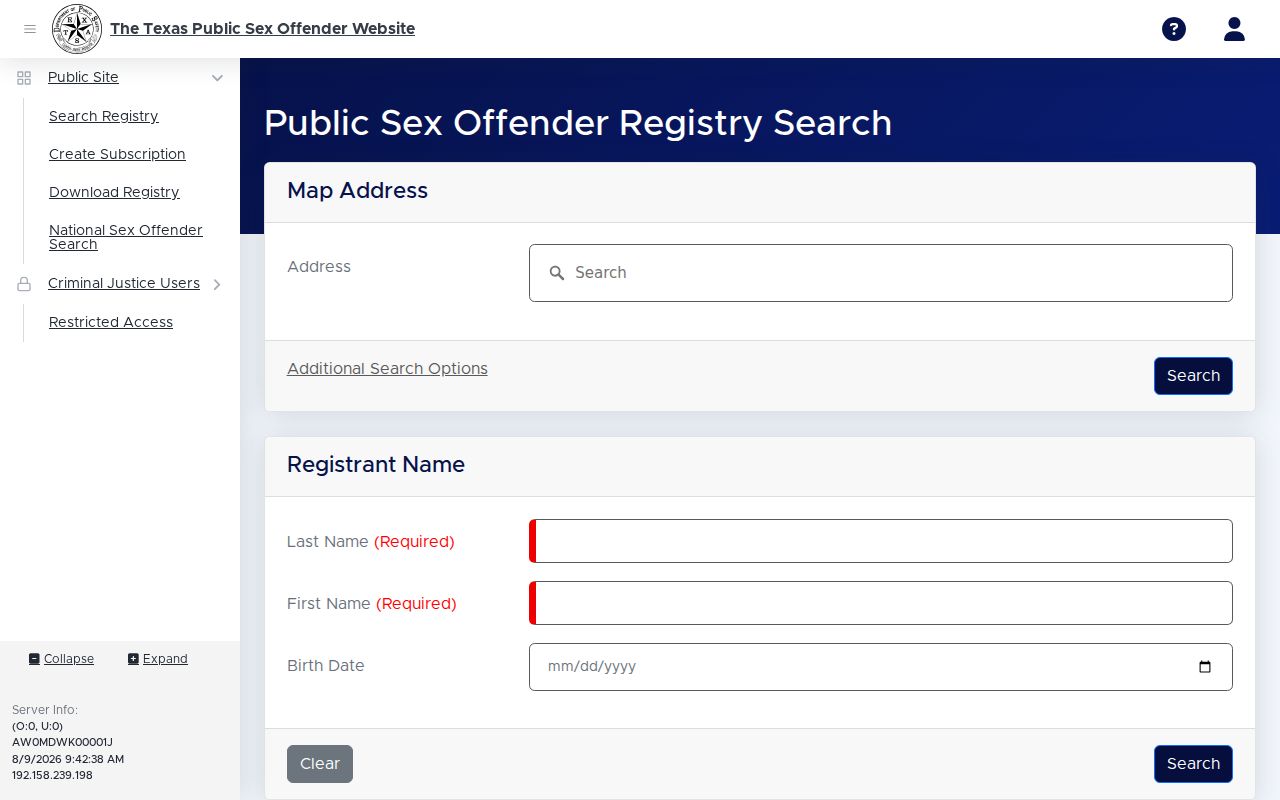
Use registry data for safety and awareness. Do not threaten, harass, confront, or infer a victim's identity. The federal National Sex Offender Public Website adds cross-state coverage.
re:SearchTX Is Not Odyssey
re:SearchTX is Texas's statewide e-filing document environment, but it is not a guaranteed complete public criminal-name index. Participation, registration, access, documents, and charges can vary. Anderson County directs local users to Odyssey for its principal public case, calendar, jail, and bond categories.
The statewide environment has its own interface and access rules.
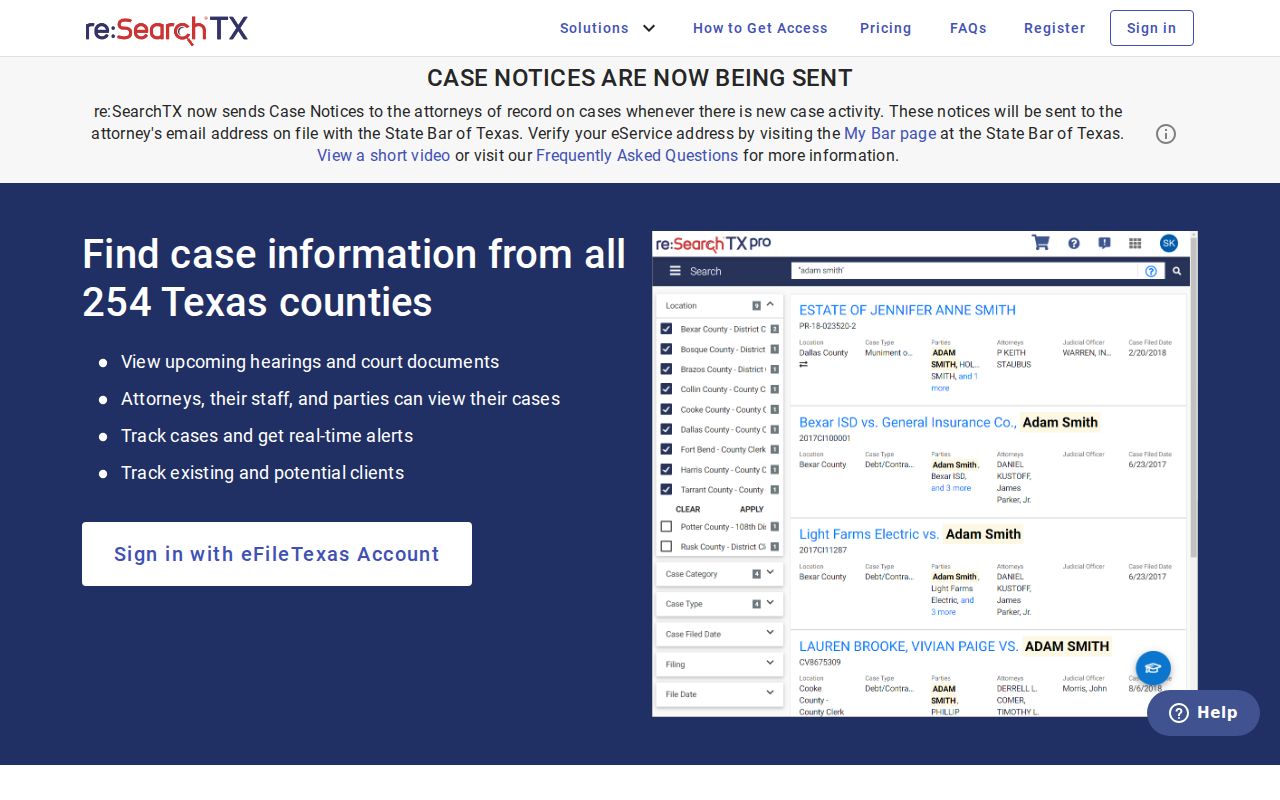
Use re:SearchTX as a document environment and supplemental route. Use the Anderson County clerk and Odyssey when the goal is the county's own criminal index or an authenticated copy.
City-by-City Criminal Records in Anderson County
City agencies add records that do not begin at the county courthouse. Palestine Police keeps incident and arrest reports, publishes weekly field reports, and routes Class C matters to its municipal court. Elkhart relies on City Hall and its municipal court clerk because no verified online police-record portal was found. Frankston accepts written public-information requests through City Hall and operates a separate municipal court channel. Arrests from each city may later appear in the Anderson County jail and court systems.
Palestine Record Check
Police records, weekly field reports, municipal cases, and county follow-through.
Elkhart Record Check
City Hall, municipal court files, and Anderson County escalation routes.
Frankston Record Check
Police requests, municipal procedure, and cross-county booking cautions.
Municipal Class C records remain criminal case records even though they are not felony or county-level misdemeanor files. Start with the city that created the report, then follow any booking or filed charge to Anderson County.