
Palestine Criminal History Checks
Start at city level when Palestine Police or a city inspector created the record. A police narrative, body-camera segment, CAD entry, field-report summary, and municipal citation do not all share one custodian. Use this sequence to avoid asking the county clerk for a city police file or asking the police records clerk to confirm county jail housing.
- Browse Palestine Police Field Reports for a recent event by week, time, block, call type, and response.
- Request the full city-held record through the public-information web form, email, fax, mail, or counter.
- Contact Palestine Municipal Court for Class C, traffic, ordinance, and other fine-only city filings.
- Use Anderson County Odyssey for county jail custody and any later Class A, Class B, or felony filing.
- Use the Texas DPS public conviction search for reported statewide convictions or deferred adjudications, or FAST for review of your own fingerprint record.
A city arrest may create files at Queen Street police and court offices, the Lacy Street county jail, and the Church Street county courthouse. The newest event may appear in a weekly report before a filed court case exists.
For a known municipal warrant, contact the Palestine court before assuming an online payment cleared it. The court distinguishes an arrest warrant from a capias pro fine. A standing order gives some people who voluntarily appear on an unpaid-fine warrant a route to community service, but it does not promise recall in every case. Confirm both court action and the law-enforcement update.
Palestine Public Information Form
Palestine’s online public-information form does not require an account. Signing in only saves and autofills details. Required requester fields include first and last name, address, city, state, ZIP, phone, email, a records description, and reCAPTCHA.
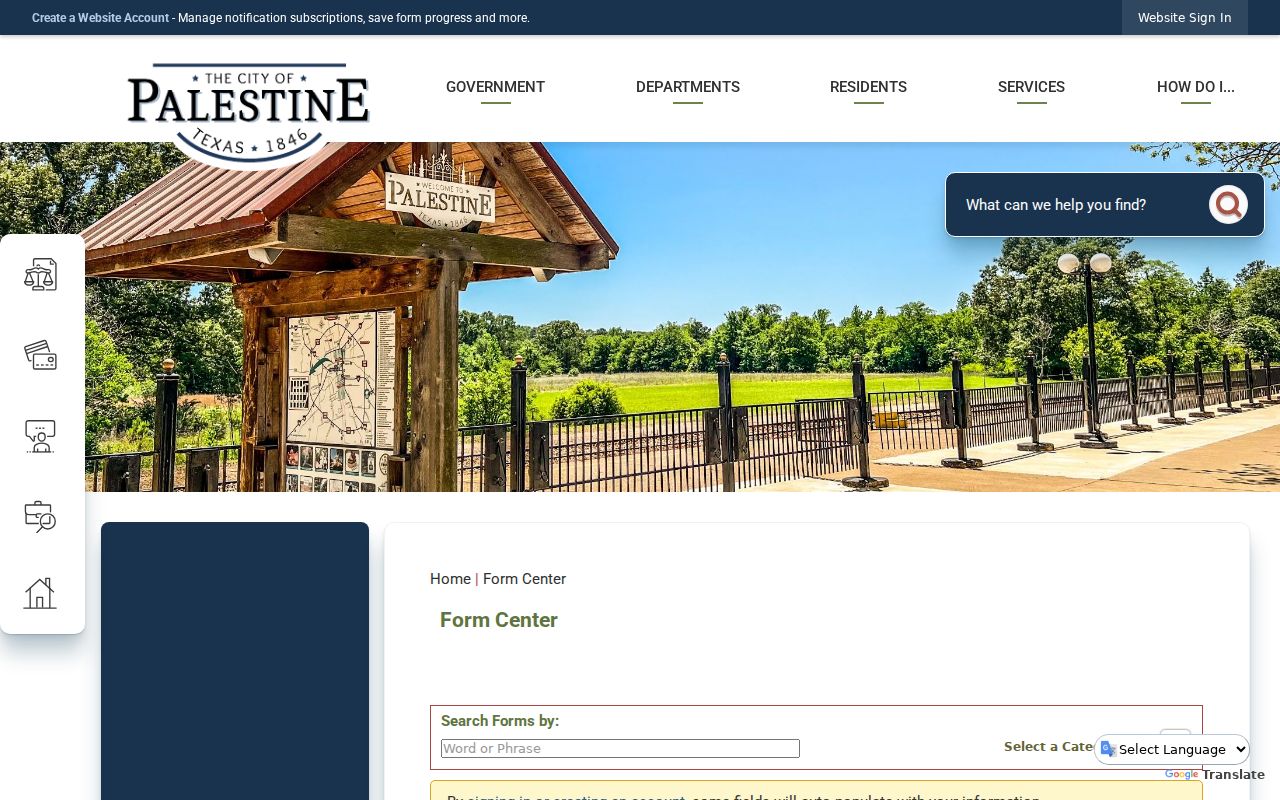
The description does the most work. Give the date, approximate time, location, incident or report number if known, and requested medium. For body-camera video, the city asks for the date and approximate time, the specific location, and at least one known subject’s name when available. The city may charge for retrieval or copies and sends written notice if it cannot produce the record within ten business days.
The form also contains internal tracking fields for a due date, responsible personnel, retrieval time, page count, and charges. Those fields show why a focused Palestine request can be easier to process than a broad demand for all material about a person. If a record may be excepted from release, the city can seek an Attorney General decision instead of simply producing the unredacted file.
Records at Palestine Police
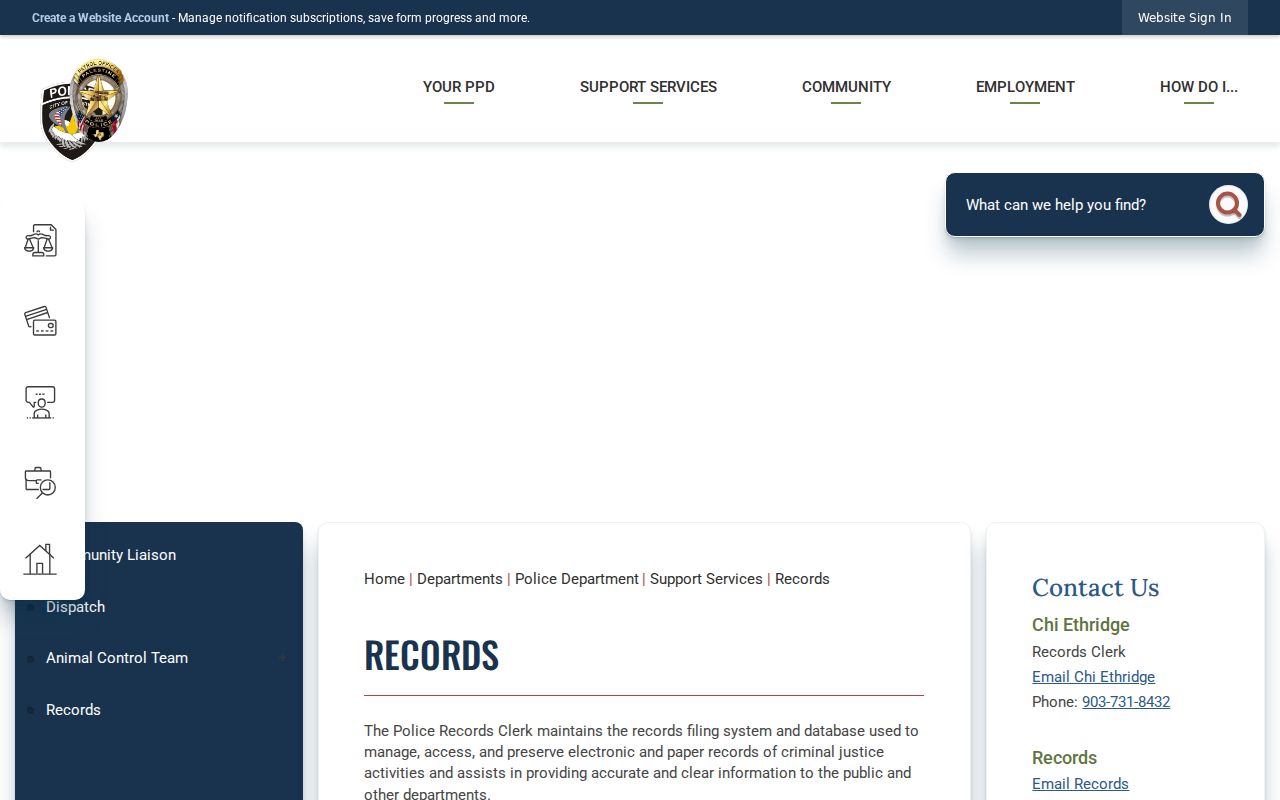
Palestine Police and its Records Clerk operate at 504 N. Queen Street. Records Clerk Chi Ethridge can be reached at 903-731-8432; the department’s nonemergency number is 903-729-2254 and administration is 903-731-8436. The records unit maintains paper and electronic criminal-justice material, but formal public requests run through the City Secretary and open-records process.
The official Palestine Police records page identifies the unit and its city role.
Requests can also go to citysecretary@palestine-tx.org, fax 903-731-8485, the Development Services Window, or the open-records phone at 903-731-8414 for routing help. A phone call can locate the custodian, but a Texas Public Information Act request must be written.
Palestine Weekly Police Field Reports
The city’s Police Field Report index offers a fast first look at recent calls. Each report can show an event time, block, incident or call type, response, and an arrest or booking reference. Reports are chronological and include a due-process notice. They are not a person-name lookup, full narrative, or statement of guilt.
Use the summary to frame a precise records request. If an entry mentions transport or booking, switch to Anderson County Odyssey Jail Records for custody. Then check a court channel later for the filed charge and disposition. This keeps three distinct Palestine record stages in the right order.
Booking and Arrest Records in Palestine
Palestine Police reports confirm that city arrestees can be transported to Anderson County Jail, and the police FAQ routes jail questions to the Sheriff at 903-729-6068. The county’s Odyssey Jail Records category accepts names, date of birth, booking or release dates, and booking number. Its landing notice says information is current through the prior business day, so immediate custody may require a call.
The city keeps the arrest or incident report. The sheriff keeps the booking and custody entry. If a prosecutor files a Class A or B misdemeanor or felony, the county clerk chain holds the later case. For deeper county custody coverage, use the Anderson County arrest search. An arrest remains an allegation, and the booking charge may differ from the filed charge.
Palestine Class C Record Split
Palestine Municipal Court handles more than traffic tickets. Fine-only cases can come from Police, the Fire Marshal, and Code Enforcement under the Transportation, Penal, Alcoholic Beverage, Health and Safety, and Education Codes or city ordinances. Searching only Anderson County’s felony portal can therefore miss a city case.
P.L.A.C.E., which combines Police, Litter, Animal Control, and Code Enforcement, adds another city-specific source of ordinance activity. A code-enforcement matter may create an administrative city record and a municipal court file without creating a county jail booking.
The difference also shapes what a record proves. A field report shows a police response. A municipal complaint shows the charge placed before the city court. A docket records pleas, settings, orders, and disposition. None of those records alone supplies a complete statewide history, and none should be treated as proof beyond what its own stage documents.
The Palestine Municipal Court File
Palestine Municipal Court shares the 504 N. Queen Street location. Judge Brenda Johnston presides, and the court can be reached at 903-731-8433. Posted hours are Monday through Thursday from 8 a.m. to 5 p.m. and Friday from 9 a.m. to 5 p.m. Online, phone, email, mail, and counter channels exist, though the court cannot give legal advice.
| Court | Palestine Municipal Court. |
|---|---|
| Case types | Class C misdemeanors, traffic, city ordinances, and fine-only matters from several city departments. |
| Access | Online, phone, email, mail, and the court counter. |
| File contents | Complaint or citation, plea, settings, warrants or capias activity, payments, orders, and disposition as applicable. |
| Copies and fees | Ask the clerk for current copy options; a local fee schedule was not verified in the reviewed sources. |
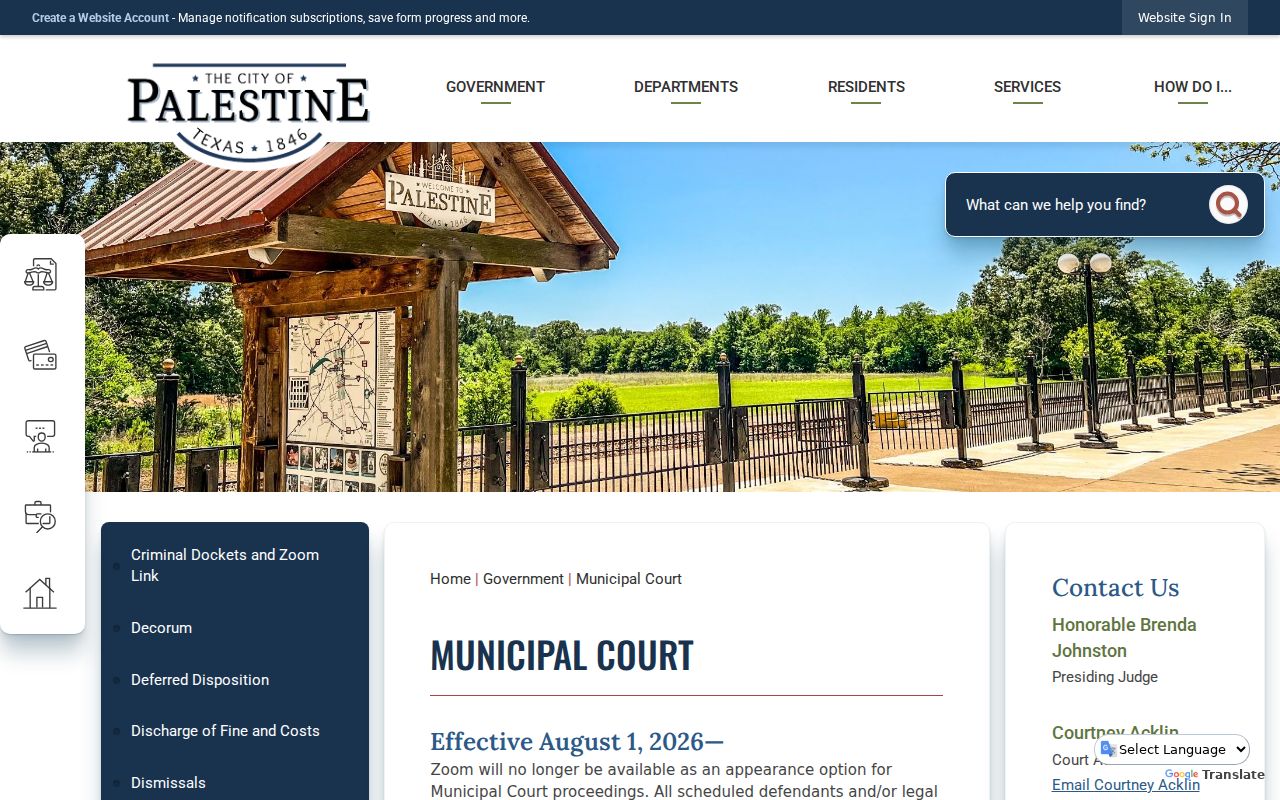
The official court page carries current contact and appearance information.
The municipal file answers whether a fine-only city charge was filed and how it ended. It does not replace the police narrative or county booking record.
Palestine Court Ends Zoom Appearances
Effective August 1, 2026, Zoom is no longer the general Palestine Municipal Court appearance channel. Scheduled defendants and guardians must appear in person unless the court directs otherwise. That current rule can conflict with an old notice or saved calendar entry, so confirm instructions directly at 903-731-8433.
The change affects appearances, not the basic right to seek a public court record. Counter hours also differ from the police department’s nonemergency dispatch function. Contact the court for municipal case activity and the police records unit for an incident file.
Moving violations, failure to maintain financial responsibility, and no-driver-license matters can also affect a driving record. That consequence belongs to the court and driver-record systems. It is not a feature of the DPS criminal-history name search, which has a different legal scope and data source.
Palestine DWI Record Reporting
DPS reporting tables illustrate why Palestine records can appear at different stages. The 2024 row lists 80 DWI charge reports, 61 prosecution actions, and 31 court actions. At the 2025 report cutoff, it lists 97 charges, 43 prosecution actions, and four court actions. These are CCH linkage and completeness counts, not a crime rate, conviction total, or count of unique people.
The gap between columns can reflect the reporting timeline. A police charge record may reach the chain before a prosecutor or court action. Readers should verify an individual outcome in the actual Palestine or Anderson County court file instead of using an aggregate table to infer guilt. The report’s cutoff date also limits any year-to-year comparison.
How Palestine Records Reach the County
A reportable custodial arrest starts with Palestine Police and can produce a separate sheriff booking. Prosecutors decide what to file. Municipal fine-only cases stay in the city court, while higher-level charges move to Anderson County clerks and courts. Reporting agencies then send qualifying arrest and disposition data to DPS.
Record flow: Palestine Police › Anderson County Courts › Texas Department of Public Safety
Check the city’s weekly report for very recent activity, the county jail for booking, and the correct clerk for a filed case. DPS’s public name product shows allowed Texas conviction and deferred-adjudication data, not every police contact or a complete fingerprint history.
Palestine Records Across Three Centers
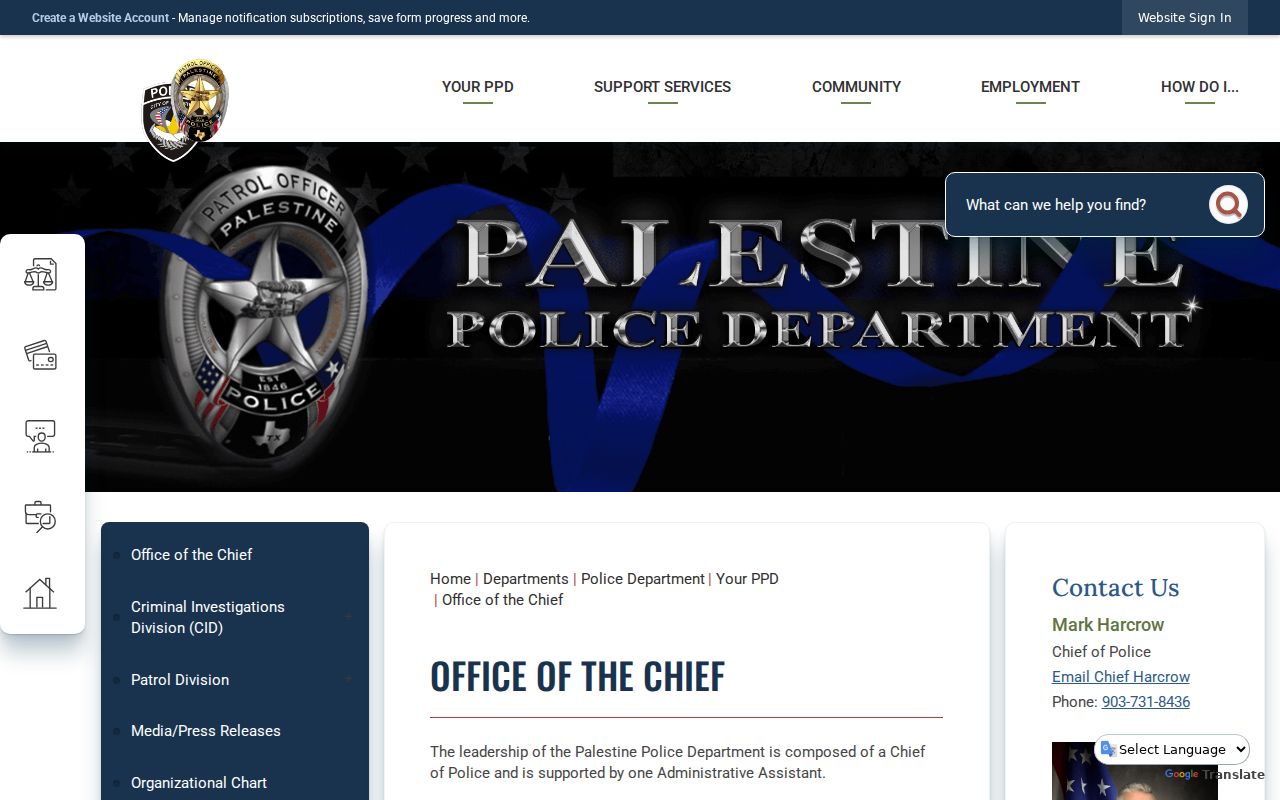
The police chief’s official page shows the Palestine police and municipal building that anchors the Queen Street route.
Local geography explains why one search can span several places. Palestine began around its 1846 square. The railroad’s 1872 arrival formed distinct Old Town and New Town centers, and county justice offices later centered around the historic courthouse. Today, city police and court records sit on Queen Street, jail records on Lacy Street, and county court files around Church Street.
That spread is not duplication. Each office records a different stage. Ask Queen Street for the city event, Lacy Street for custody, and the proper county clerk for a filed higher-level charge.
Palestine’s size helps explain the deeper city access system. The 2020 Census counted 18,544 residents, and the official 2025 estimate reached 19,555. Those figures dwarf the county’s other incorporated towns. The population supports a dedicated records clerk, weekly police summaries, a web request form, and several municipal court channels, yet county and state offices still control later stages.
Palestine Record Access Rules
The Texas Public Information Act applies to city administrative and police records, but court records also follow judicial access rules. Government Code §552.108 may protect material whose release would interfere with an investigation or prosecution. Basic information about an arrest or crime cannot be withheld under that exception, while juvenile, victim, driver-license, Social Security, and confidential criminal-history data can remain protected.
Key Statutes:
Texas Public Information Act - creates the written request process and sets disclosure rules for city records.
Government Code § 552.108 - permits certain law-enforcement withholding while preserving access to basic information.
Government Code Chapter 411 - limits dissemination of confidential criminal-history record information.
If city staff believes an exception requires withholding rather than ordinary redaction, the process may involve an Attorney General ruling. Describe the exact record instead of requesting a broad “criminal history.”