
Anderson County Sex Offender Checks
The free Texas Public Sex Offender Registry is the official statewide search channel. It accepts name, address, map, county, and Texas SID routes. Anderson County did not supply a separate public sheriff registry in the reviewed sources, so DPS is the supported public index. NSOPW adds an official national layer when an address lies near a county or state line.
Prepare the most precise lawful fact available. A full name can reduce false matches. An address or map search is better for local awareness, while the Anderson County filter provides a broad county view. Result dates and verification status matter. A current address is not the same field as an offense date, conviction court, or registration end date.
Anderson County Registration Offices
A registrant who lives inside a municipality normally reports to that city's police department. A person outside municipal limits generally reports to the Anderson County Sheriff. The registering agency verifies required data and sends it to Texas DPS. This city-versus-county line matters when a listing appears stale or suspected noncompliance needs review.
Use the profile's verification-agency field to identify the most likely local office. Do not confront the listed person or household. Report a suspected failure to register to the named agency or other local law enforcement with the public profile and the specific discrepancy.
Texas Public Sex Offender Registry Searches
Texas DPS operates the public registry from data supplied by local registering authorities. Its search controls support both person-based and place-based checks. Use Anderson in the county dropdown for a county list, or use address and map modes for a smaller area. Exact radius increments should be confirmed in the live interface because the research did not verify each choice.
- Open the DPS registry and review its conditions of use.
- Select name, address, map, county, or SID search.
- Enter precise fields and use Anderson as the county when needed.
- Open a likely match, compare lawful identifiers, and read status and verification dates.
| Field Label | Type | Required | Notes |
|---|---|---|---|
| Last / First Name | Text | For name route | Registrant name |
| Street / City / ZIP | Text | For address route | Location inputs |
| County | Select | No | Includes Anderson |
| SID | Text | For SID route | Texas identifier |
| Current / Address Type | Filters | No | Status and location filters |
| Radius / Map | Map control | No | Geographic search |
The DPS search form displays these registry controls.
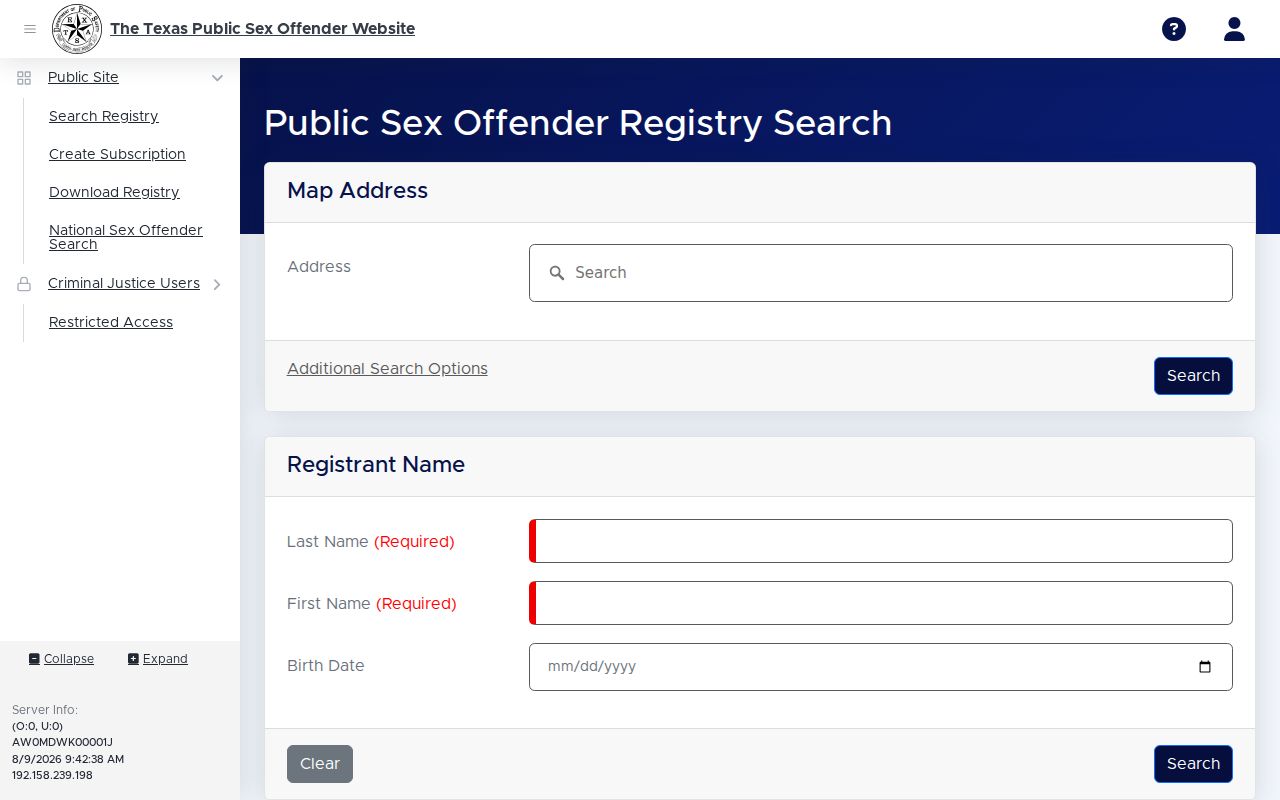
The interface permits both an Anderson County filter and narrower name or address searches.
Anderson County Registry App Tools
The official Texas DPS mobile app advertises registry searches by location and name, route and proximity tools, an interactive map, most-wanted information, tips, and iWatch Texas. No official Anderson County Sheriff or Palestine Police app was found, so this state app and the browser registry are the supported mobile choices.
The DPS app overview shows the official mobile feature set.
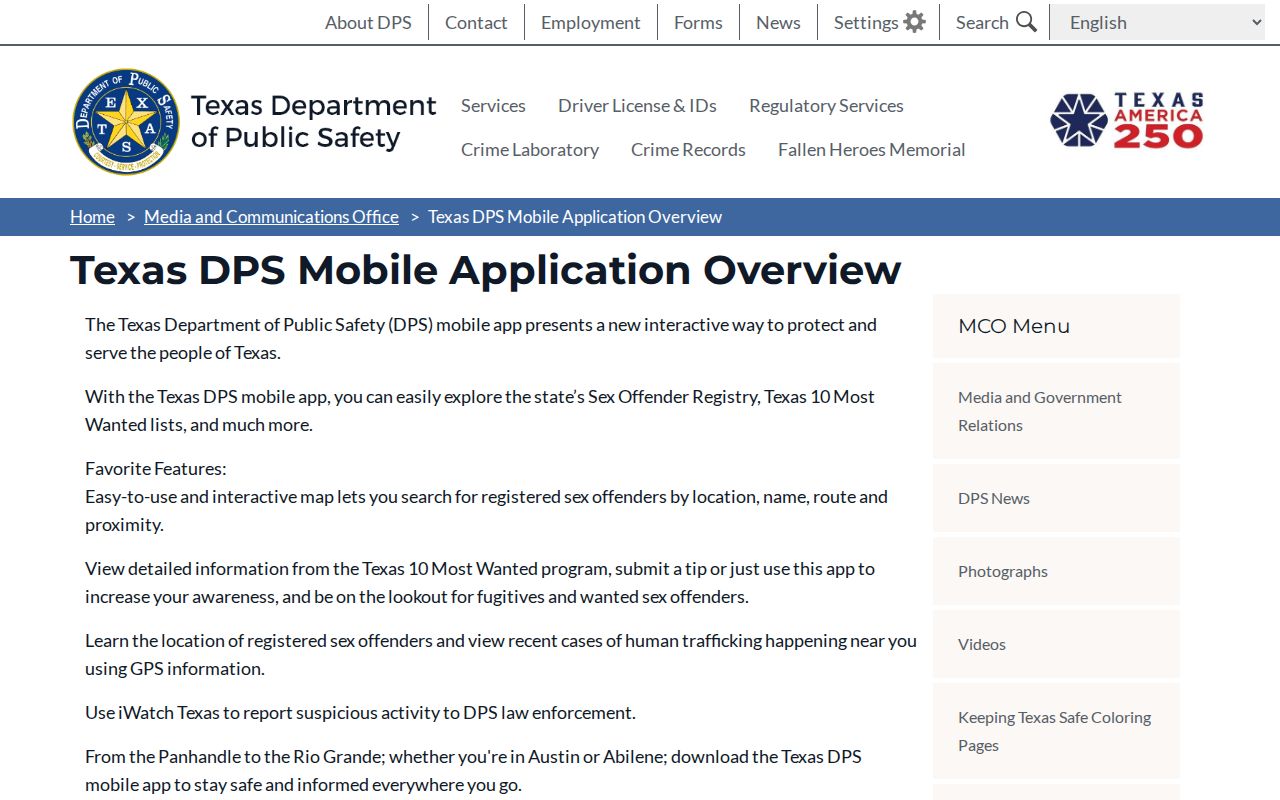
Route and proximity functions can support travel awareness, while the full public profile remains the place to review registration details.
Registry Profiles: What They Show
A Texas public profile may show a photograph, registered name and aliases, physical descriptors, marks, SID, residence or geographic description, address type, verification agency, status, risk label, verification dates, reportable offense, statute, adjudication court and date, punishment, supervision status, and registration duration. Victim age can appear without identity.
| Name & Aliases | Registered and alternate names. |
|---|---|
| Photo & Physical Description | Photograph, build, features, marks, scars, and tattoos. |
| Registered Address | Residence or geographic description and address type. |
| Offense & Statute | Reportable offense, law, court, and adjudication date. |
| Risk Information | Texas risk label and related public status fields. |
| Registration Status | Verification agency, event dates, frequency, and end date or lifetime display. |
Texas withholds Social Security and driver-license numbers, personal phones, online identifiers, employer identity and contact, victim identity, confidential additions, and qualifying juvenile data. The DPS registry FAQ explains public and nonpublic fields.
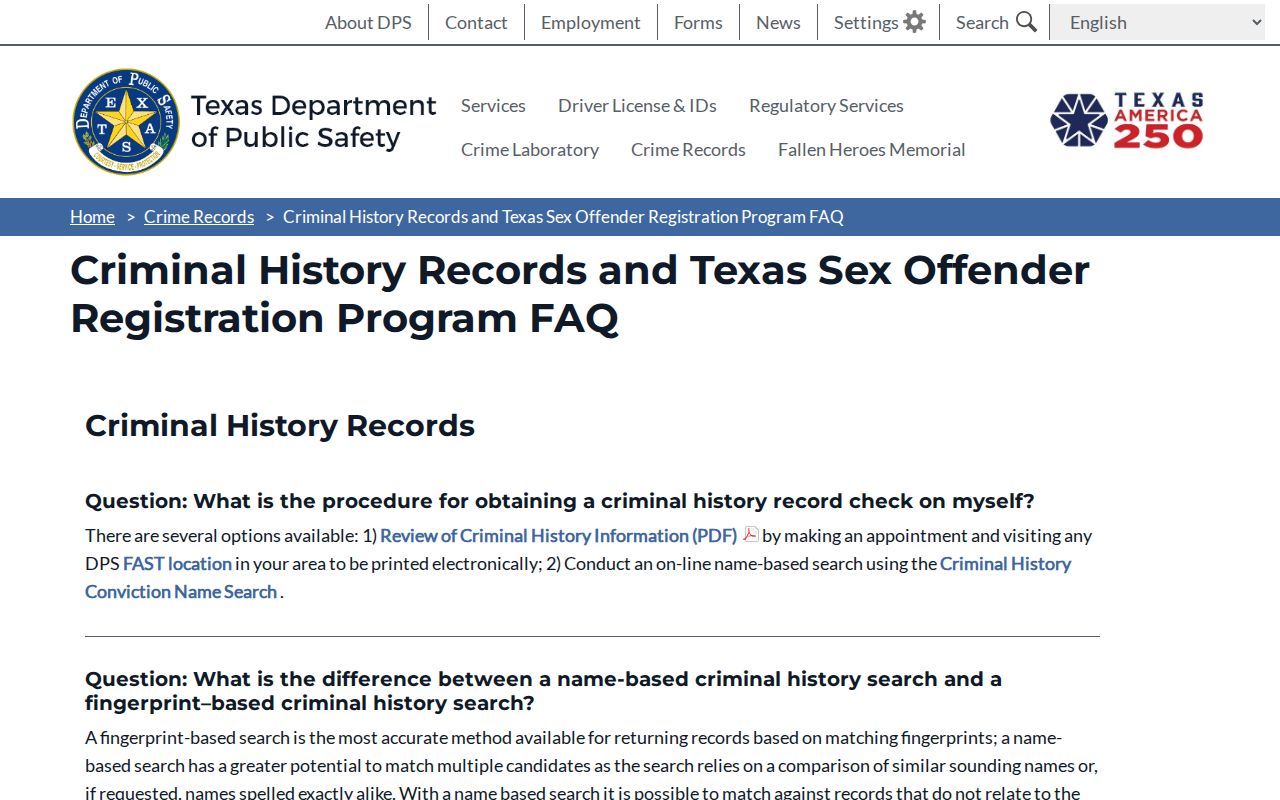
Those limits protect sensitive data while leaving the registration facts DPS authorizes for public awareness.
NSOPW Near Anderson County Lines
The National Sex Offender Public Website searches participating public registries across jurisdictions. It is useful near county or state boundaries or when a person may have registration data outside Texas. It does not replace the Texas profile for state-specific fields, local verification agency, or current Texas duration detail.
The official NSOPW interface supplies that cross-state layer.
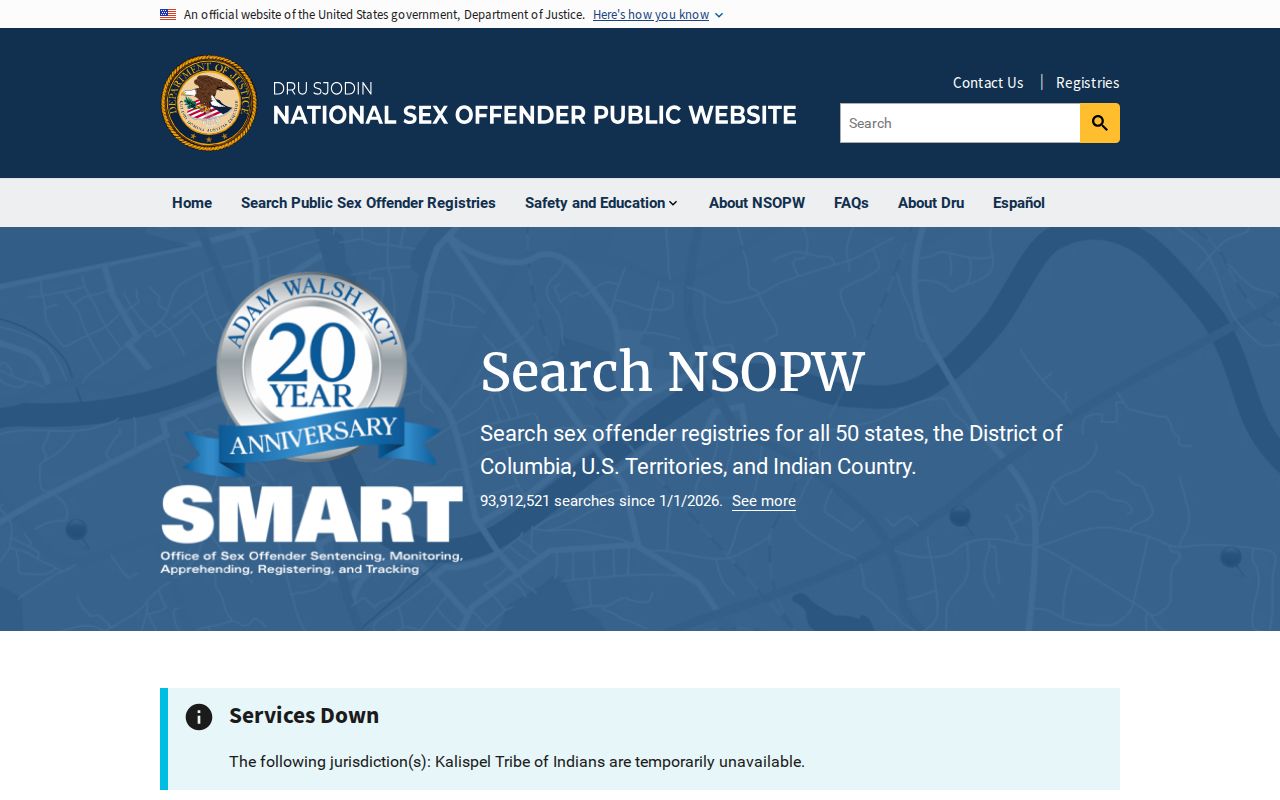
Compare a national result with the linked source registry before relying on its current local details.
Registration Levels and Duties in Texas
Texas duration follows the reportable offense and case route, not a simple federal Tier I, II, or III label. Texas risk labels of low, moderate, or high relate to assessment and notification, not registration length. Verification frequency is also a separate rule. Civilly committed sexually violent predators verify every 30 days, people with two or more sexually violent offenses every 90 days, and other categories commonly verify yearly.
| Level / Tier | Duration | Verification Frequency |
|---|---|---|
| Adult lifetime-category offense | Life | Depends on statutory category |
| Other adult reportable offense | Until tenth anniversary of latest qualifying discharge, dismissal, or release | Commonly annual unless another rule applies |
| Juvenile adjudication | Tenth anniversary of disposition or completion, whichever is later | Category dependent |
| Juvenile district-court route | Tenth anniversary of release, discharge, or dismissal, whichever is later | Category dependent |
| Extrajurisdictional | Originating federal, military, or other jurisdiction's duration | As applicable |
The DPS registration overview is the official program source.
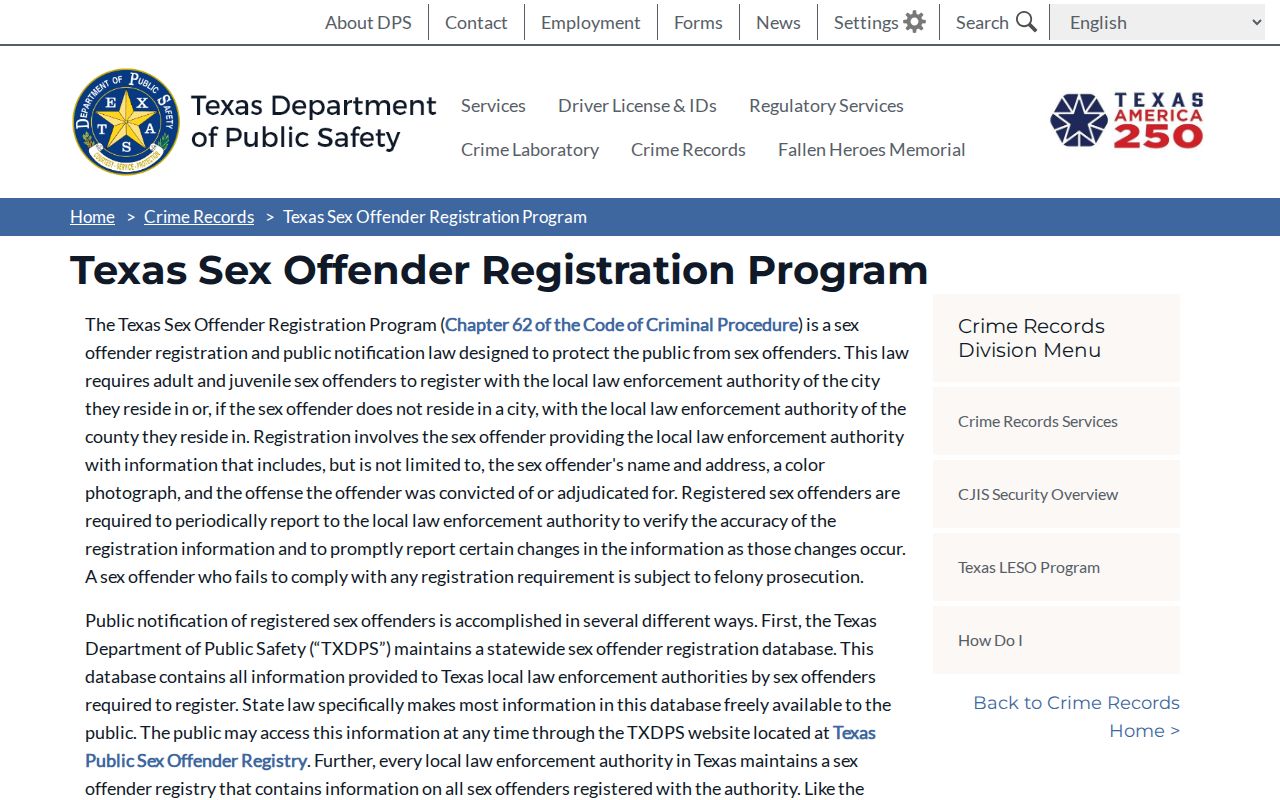
It places duration, verification, and public notification within the Texas statutory program.
Anderson County Registry Notifications
Texas community notification does not apply in one uniform form to every listing. A high-risk registrant or civilly committed person who moves can trigger bilingual postcard notice within one mile in an unsubdivided area or three blocks in a subdivision. The rule describes a notice zone, not a statewide ban on living within that distance.
Read the Anderson County registry profile alongside any notice received. Risk assessment, registration duration, verification schedule, and local residence conditions are separate facts. Mixing them can produce a false claim about the person's duties or address.
Anderson County Distance Rules
Texas has no single statewide residence-distance rule that applies in the same way to every registrant and every place. General-law municipalities may adopt child-safety-zone ordinances under Local Government Code section 341.906. A map pin alone therefore cannot answer whether a specific residence is lawful.
Check the governing local ordinance and the person's applicable court, parole, probation, or civil-commitment conditions. Avoid drawing conclusions from straight-line map distance without those sources.
Report Anderson County Registry Concerns
When an Anderson County registry listing seems out of date, record the official profile URL, the public field in question, and why it appears inconsistent. Contact the verification agency named on the profile or other local law enforcement. That office can compare the report with nonpublic registration data and decide whether follow-up is warranted.
Do not visit the address, contact relatives, or publish guesses about a victim. A public registration profile supports awareness, not a private investigation. Ordinary safety measures and a concise report through an official channel protect the community without risking harassment or spreading an unsupported claim.
Using Registry Information Lawfully
Registry information supports community awareness and safety planning. For certain high-risk or civilly committed moves, Texas notification can include bilingual postcards within one mile in an unsubdivided area or three blocks in a subdivision. That notification rule is distinct from a residence restriction and from the public search.
If a listing appears noncompliant, preserve the official URL and visible discrepancy, then contact the verification agency or local law enforcement. Do not republish victim-related inferences or hidden personal facts.
Misuse is a crime: Texas Code of Criminal Procedure Chapter 62 prohibits using registry information to harass, threaten, or intimidate. Never confront a registrant or household.